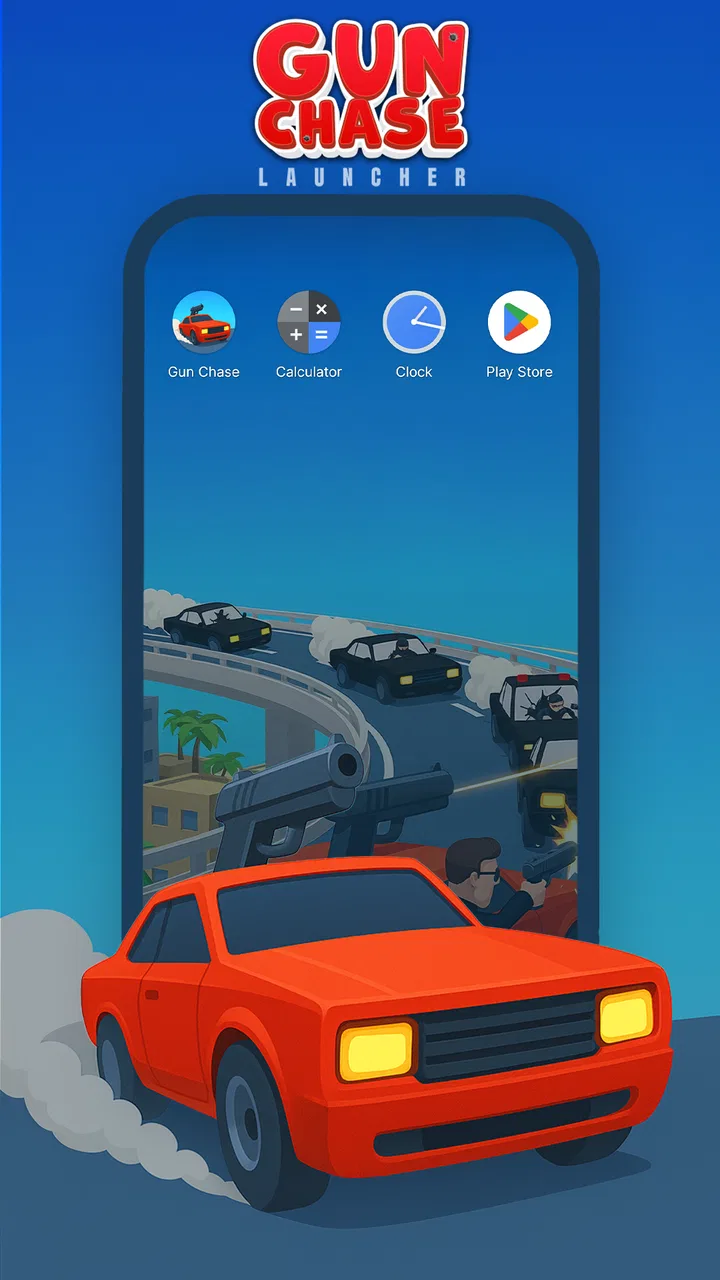
Gun Chase Launcher
- 4.7
- Rating
- 1.00M
- Installs
- Free
- Price

 Analysis by App-foxy
I spent time with Gun Chase Launcher as a personalization app, and my first impression was that its appeal depends less on deep customization and more on the mood it creates around everyday phone use. Its short store description is simply “Gun Chase,” while the broader summary invites the chase to begin. That leaves the app feeling intentionally focused rather than overloaded with promises. If you want a launcher with a strong action-oriented identity, it is easy to understand why this one attracts attention. If you are looking for a highly configurable replacement for every part of your phone interface, you may find its narrower personality more important than its feature count.
The app comes from Gamnest and is free to use. It is aimed at Teen users, so its theme is better suited to people comfortable with a stylized, game-inspired presentation than to someone seeking a quiet, minimalist home screen. I also noticed that the experience should be judged as a launcher first: the useful question is not whether the chase theme sounds exciting, but whether it makes reaching everyday apps feel pleasant and dependable.
How the chase theme works in daily phone use
A launcher has a job that is easy to underestimate. I open mine dozens of times without thinking, often while walking between tasks, checking a message, starting navigation, or looking for one particular tool. A themed launcher succeeds when its visual identity adds character without making those quick actions slower. Gun Chase Launcher has a clear concept, and that clarity is its strongest starting point. It does not feel like a generic wallpaper package that happens to sit behind icons; the name and presentation are built around an action-game atmosphere.
You May Also Like

 Blood Strike: 2.5 Anniversary
Blood Strike’s Loadouts Turn Every Drop Into a Tactical Gamble
A close look at Blood Strike’s custom loadouts: how fast access to signature weapons reshapes its battle royale rhythm, rewards preparation, and narrows the gap between fights.

 Pandora - Music & Podcasts
Pandora’s Music Is Easy to Start, but Harder to Recover
Pandora’s strength is its low-effort path from a seed to a station. Its weak spot is how much confidence it asks you to place in connection, setup, and quiet recovery.

 8 Ball Pool
 Is Built on Rivalries, Rematches, and Routine
A close look at the rivalries, rematches, shared routines, and unanswered safety questions that turn a quick pool match into a persistent mobile community.

 Samsung Music
’s Quiet Strength Is Playing What You Already Own
Its reach comes less from spectacle than from dependable access to a personal library. That simplicity is both the app’s strongest retention engine and its ceiling.

 AccuWeather: Weather Radar
AccuWeather Review: A Quick, Clear Forecast for Everyday Decisions
For everyday plans, the best forecast is the one you can understand quickly. AccuWeather makes rain timing, radar, and local conditions easy to act on, with a few trade-offs.

 Hill Climb Racing
Why Hill Climb Racing Still Turns Crashes Into One More Run
A tiny car, a bumpy hill and one more upgrade: Hill Climb Racing keeps resurfacing because its simple chaos makes every near-miss feel personal.
More From Our News Desk



That atmosphere will appeal most to users who want their phone to feel more personal immediately after unlocking it. I can imagine using it on a secondary device, a gaming-focused phone, or a handset shared with a teenager who enjoys bold themes. It also makes sense for someone who has grown tired of the standard home screen but does not want to spend an evening assembling a complete setup from separate icon packs, widgets, and wallpaper tools.
The trade-off is that a strong theme can become tiring. I would not recommend installing it solely because the word “launcher” suggests extensive layout control. People who carefully tune icon grids, folders, gestures, search behavior, and widget placement should compare their current launcher with this one before switching. A themed experience can be more memorable, but memorability is not the same as flexibility.
In practical use, I would begin with a small test period rather than immediately rebuilding every screen. Keep the most important apps visible, place communication and travel tools where your thumb naturally reaches them, and see whether the visual style remains comfortable after the novelty fades. This is a useful way to judge any launcher, but it matters especially here because the app’s identity is such a prominent part of the experience.
Where connectivity changes the first impression
Connectivity matters most during setup and discovery. A launcher is not something I use in isolation from the rest of my phone: I may be connected to home Wi-Fi, using mobile data outdoors, or moving through a weak signal area when I decide to change my home screen. Any network-dependent part of the initial experience can therefore affect whether the app feels quick and welcoming or unexpectedly interrupted.
I would install and configure it when I have a stable connection, especially if I am changing launchers before leaving home. That simple habit avoids turning a cosmetic decision into a rushed task at a bus stop or in a parking lot. It also gives me enough time to check the layout, place frequently used apps, and decide whether the theme works with my normal brightness and wallpaper preferences.
Once a launcher is configured, the important test is how little it gets in the way. I do not want to wait for a network response just to open the camera, read a message, or start a call. Because the available information does not establish which parts of Gun Chase Launcher require connectivity, I would avoid assuming that every visual element behaves the same way online and offline. My advice is practical: test the home screen in the places where you commonly lose signal before relying on it as your everyday interface.
This is also why I would not judge it only from a strong Wi-Fi session. Try opening the app drawer, moving between home screens, and launching your essential apps with mobile data disabled or with a weak connection. The purpose is not to prove a technical claim; it is to discover whether your own routine feels uninterrupted. A launcher should remain predictable when the network is not.
A realistic mobile routine
Imagine a normal weekday. I leave home while connected to Wi-Fi, check a calendar or message on the way out, then switch to mobile data for maps and music. At lunch, I open the phone repeatedly in short bursts, often with one hand. In the evening, I may be on a crowded network or almost out of battery. In that routine, the value of Gun Chase Launcher is not the number of times I admire the theme. It is whether I can find the same essential apps without hesitation in every context.
For that reason, I would keep the first home screen deliberately practical. Put the phone, messages, camera, maps, and settings tools in familiar positions, then reserve another screen for less urgent apps. This reduces the risk that the action-oriented presentation encourages a decorative layout that looks good but slows down real tasks. The most useful customization is often the least dramatic: consistent placement, readable labels, and a short path to the apps you use under pressure.
One non-obvious benefit of testing this way is that it separates the launcher’s theme from its navigation value. If I enjoy the look but repeatedly swipe past the app I need, the problem is not solved by liking the artwork. Conversely, if the layout becomes second nature after a few days, the app earns its place even when I am no longer impressed by the first launch.
I would also test it while holding the phone in my usual hand. A layout that feels fine when tapping with two hands may be awkward when I am carrying a bag or standing on public transport. That matters more for a launcher than for a static wallpaper because every interaction begins from the home screen.
What happens when the connection or setup goes wrong
Switching launchers is a moment when small failures feel larger than they should. If the app does not open as expected, if a screen takes longer to appear, or if I accidentally select the wrong home app, I need a calm recovery path. My preferred approach is to change one thing at a time: install the launcher, inspect its initial arrangement, make a modest adjustment, and only then decide whether it should become the default.
I would keep the previous launcher available until I am satisfied. That is not a criticism unique to Gun Chase Launcher; it is sensible protection whenever the home screen is being replaced. If the new setup does not suit me, returning to the familiar launcher is easier than trying to reconstruct a layout while frustrated. I would also avoid making the switch immediately before an important trip or work call.
Connectivity can complicate recovery because users may assume that a delayed screen means the launcher is broken, when the real issue could be a temporary network condition or an incomplete first-run process. I would retry from a stable connection, close and reopen the app, and check whether the phone’s default-home selection still points to the intended launcher. Those are straightforward steps, but they prevent a short interruption from becoming a reason to abandon the app prematurely.
There is another practical recovery concern: themed launchers can change the visual cues I normally use. If icons or labels look different, I may open the wrong app even though everything is functioning correctly. During the first day, I would leave important apps in obvious positions and avoid hiding them inside elaborate folders. Familiarity is a recovery tool; the less I have to remember, the easier it is to correct a mistake.
I would skip the app if I need a launcher that must be completely predictable during a weak-signal emergency and I have not had time to test it in that condition. The app’s concept is attractive, but a distinctive presentation should never take priority over reliable access to calls, messages, navigation, or accessibility tools.
Using it without wasting attention or data
Personalization apps can encourage repeated browsing because users naturally want to compare looks, adjust screens, and keep experimenting. That is enjoyable when I have time, but it can become distracting when I only wanted to open one app. I find the best balance by treating the launcher as a finished workspace rather than a permanent project. Once the essential layout feels right, I stop changing it every few minutes and let muscle memory develop.
For data-conscious users, the safest habit is to perform discovery and setup on Wi-Fi, then observe the app during ordinary mobile use. I would not assume that every theme element, preview, or update behaves identically across connections. If the app offers visual content that loads during customization, browsing less frequently on mobile data is a sensible way to keep control of usage. This is a usage recommendation, not a claim about a particular data policy.
Battery awareness is equally important for a launcher because it sits close to the start of nearly every phone session. I would watch how the phone behaves over a normal day rather than deciding after a few minutes. Pay attention to warmth, responsiveness, and whether the home screen feels instant after the display wakes. If the themed experience makes the phone feel less responsive than the standard launcher, that is a meaningful trade-off even if the appearance is more exciting.
A useful workflow is to keep only the visual changes that improve recognition. For example, if the action theme helps me distinguish the home screen from a work device, it has practical value. If it merely adds clutter around apps I already struggle to find, I would simplify the arrangement or return to a plainer alternative. The best personalization is not the most intense personalization; it is the one that supports the way I actually use the phone.
Who should install it, and who should look elsewhere
Gun Chase Launcher is a good fit for Android users who want a free, game-flavored identity on the home screen and prefer a ready-made direction to building a theme from separate components. It is also worth considering for a personal device that feels visually dull, particularly if a Teen-friendly action style matches the owner’s taste. The app has reached more than a million installs and holds a 4.7 average from around 9.5 thousand ratings, which suggests that the concept has found a substantial audience. Those figures are encouraging, but they do not replace checking whether the style suits your own habits.
The current release is version 1.0.3, and it supports Android 8.0 and later. That makes compatibility a straightforward first check before installation. I would also remember that a launcher affects the most frequently visited part of the operating system, so personal preference matters more here than it might with an app used once a month. A high average rating can indicate broad satisfaction while still leaving room for users who prefer a calmer or more configurable interface.
I would choose a conventional productivity launcher instead if my priority is dense information, extensive widget control, advanced gestures, or a restrained visual design. I would choose a manufacturer’s default launcher if stability and tight integration matter more than theme. I would choose a separate wallpaper or icon solution if I want to refresh the appearance without replacing the whole home-screen experience. Gun Chase Launcher makes the most sense when the theme itself is part of the reason for switching.
Another group that should think twice is anyone who frequently changes devices or depends on a carefully synchronized layout. Recreating a personalized setup can be inconvenient if the launcher does not match the transfer tools or habits used on those devices. Before committing, I would note the placement of essential apps and make sure I can return to a familiar arrangement without losing time.
My connectivity verdict after living with the idea
My view is that Gun Chase Launcher should be approached as a focused personalization choice, not as a promise to transform every part of Android. Its strongest quality is its distinctive identity: it gives the home screen a clear action-game mood instead of asking me to design one from scratch. Its main risk is equally clear: users who value quiet efficiency, deep control, or guaranteed familiarity may find the theme more noticeable than useful.
Connectivity should shape how I adopt it. I would set it up on a reliable network, test the essential home-screen actions with inconsistent connectivity, and avoid assuming that every customization element is available in every situation. That small amount of preparation answers the questions that matter in daily use: Can I reach my important apps quickly? Does the interface remain comfortable when I am moving? Can I recover easily if the first setup is not right? Does the visual style justify replacing the launcher I already know?
Gamnest has made a free app for a very specific taste, and I appreciate that focus more than a vague collection of unrelated themes. I would recommend trying it to someone who wants their phone to feel more like a personal gaming space and is willing to spend a little time arranging the practical shortcuts around that idea. I would not recommend it to a user who sees the launcher as invisible infrastructure and wants it to disappear completely.
After the initial excitement, the deciding factor is simple: the chase theme must help the phone feel more enjoyable without making ordinary actions harder. If it passes that test on both Wi-Fi and mobile data, it can be a fun change from the standard Android home screen. If it does not, returning to a simpler launcher is the better choice. For me, its value comes from personality supported by dependable everyday access, not from decoration alone.
FAQs for Gun Chase Launcher
01What is Gun Chase Launcher and how does it work?
Gun Chase Launcher is an action-packed game that combines elements of arcade shooting and strategic gameplay. Players take on the role of an elite agent tasked with chasing down criminals through fast-paced levels. The game offers a variety of weapons and upgrades, allowing players to enhance their skills and tackle increasingly difficult challenges.
02Is Gun Chase Launcher free to play?
Yes, Gun Chase Launcher is free to download and play on both Android and iOS platforms. However, it features in-app purchases that allow players to buy in-game currency and items. These purchases are optional, and the game can be enjoyed fully without spending money, though some features may be more accessible through purchases.
03What are the system requirements for Gun Chase Launcher?
Gun Chase Launcher requires iOS 11.0 or later for Apple devices and Android 5.0 or higher for Android devices. It is recommended to have at least 2GB of RAM and sufficient storage space for smooth gameplay. The app is optimized for both smartphones and tablets, providing a seamless experience across different devices.
04Does Gun Chase Launcher require an internet connection?
Gun Chase Launcher offers both offline and online modes. Players can enjoy the core gameplay without an internet connection. However, certain features, such as leaderboards and special events, require connectivity. For the best experience, it’s recommended to play online to access all game features and updates.
05How does Gun Chase Launcher handle player data and privacy?
Gun Chase Launcher adheres to strict privacy policies to ensure player data is protected. The app collects data necessary for gameplay enhancement and user experience improvement but does not share personal information with third parties without consent. Players can review the privacy policy within the app settings for more detailed information.
Pros
- Smooth and intuitive controls.
- Visually appealing graphics.
- Wide variety of weapon options.
- Engaging and dynamic gameplay.
- Frequent updates with new features.
Cons
- In-app purchases can be costly.
- Occasional ads can interrupt play.
- Requires a stable internet connection.
- Some levels may feel repetitive.
- High battery consumption on older devices.

Gun Chase Launcher
Gallery